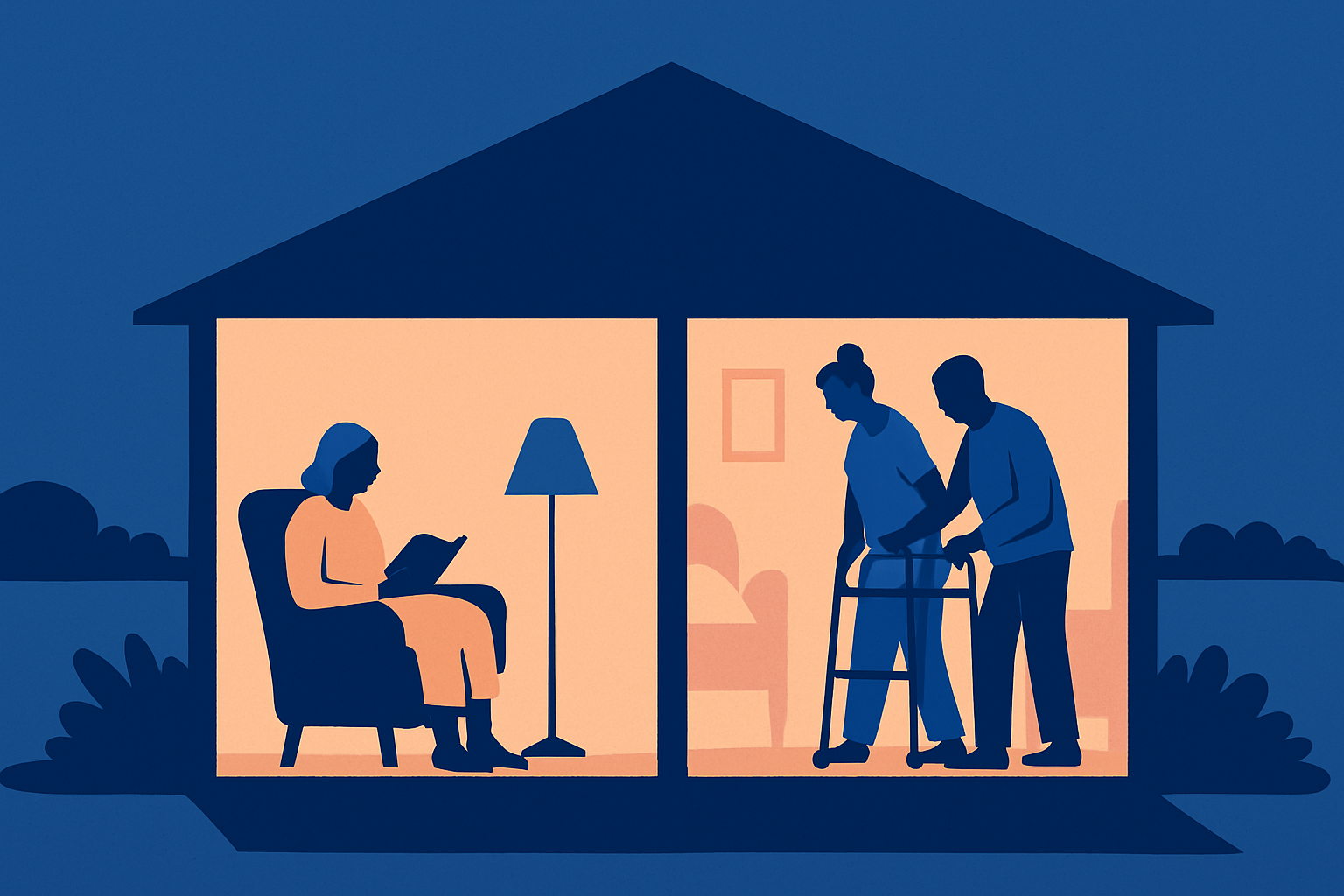
Aging in place is often described as 'free' because the house is paid off. But there are significant costs to remaining in our homes as we age. Home modifications, in-home care, property maintenance, utilities, taxes, and the unpaid hours of a family caregiver are real costs, and most families do not put numbers on them until they are forced to. Side-by-side with assisted living, the math is more honest than the language around it.
This is the cost-comparison worksheet I sit down with families to fill in. Median figures from the Genworth Cost of Care Survey and AARP, framed as planning benchmarks (median cost as of 2024 unless noted), with the line items that consistently change the answer once they are visible. The numbers are not promises about what your family will pay; they are the median for the country and a starting point for the local conversation with a credentialed advisor.
The honest cost of aging in place
Most families estimate the cost of aging in place by what is already on the monthly statement — the mortgage if any, the property tax, the utilities. The pieces that get missed are the ones that scale with the older adult's needs, not with the house.
- Home modificationsA few hundred dollars for grab bars and a shower bench; several thousand for a no-step entry or a stair lift; twenty thousand and up for a full main-floor bathroom remodel. The Genworth and AARP surveys do not include modifications, but the audit your family runs honestly should.
- In-home careMedian cost as of 2024 for a home-health aide in the United States was roughly $33 per hour, per the Genworth Cost of Care Survey 2024 (national median; state and metro figures vary substantially). A daily aide at four hours a day, five days a week, runs into the mid-$30,000s annually before overnight or weekend coverage.
- Overnight or live-in careRoughly $300 to $400 a day for live-in care in many markets in 2024, again per Genworth — meaningfully more in higher-cost regions. Many families add this category later than they should, after the spouse caregiver is exhausted.
- Property maintenanceLawn, snow removal, gutter cleaning, the small repairs the older adult used to do themselves. Honestly priced, this is several thousand dollars a year that most family spreadsheets omit.
- Family-caregiver hoursAARP estimates U.S. family caregivers provided roughly $600 billion of unpaid care annually in recent years. Multiplied by the household, this is often the largest invisible cost on the page.
The honest cost of assisted living
Assisted living is more easily calculated than aging in place because the monthly invoice arrives in writing. The line items are still worth naming, because what is included varies by community.
- Base monthly feeMedian cost as of 2024 for assisted living in the United States was roughly $5,350 per month, per the Genworth Cost of Care Survey 2024 (national median; state and metro figures vary substantially). This includes the apartment, three meals a day, housekeeping, and the activities calendar.
- Care tier add-onsPersonal-care services beyond the basic package are typically billed in tiers (Level 1 through Level 4 or similar), each adding several hundred to over a thousand dollars a month depending on the level of help needed.
- Move-in and community feesA one-time community fee (often $1,500 to $5,000) and the cost of the move itself.
- Rate increasesAnnual rate increases in 2022–2024 have run meaningfully above general inflation in many markets. Ask each community for the rate-increase history of the last five years before signing.
- What is not includedAsk if the following are included, or an additional cost: cable, internet, transportation outside the community schedule; medical treatment and prescription drugs will continue to be billed to insurance; and (in most communities) a guest meal program is available for visiting family.
A note on Medicare and Medicaid: Medicare is a federal health-insurance program; it covers short-term post-hospital care, not long-term residential care, and it does not pay assisted-living rent. Medicaid is a state-administered program that covers long-term care (nursing home) for people with limited assets, with some states offering an assisted-living waiver and most others limiting coverage to nursing-home care. Your local Area Agency on Aging can help you understand local options. Both programs are sources you can read at medicare.gov and medicaid.gov; eligibility and benefits in your state should be confirmed with a credentialed elder-law attorney.
The side-by-side worksheet

Run both columns for one year, then for five years. Most families discover the same thing: the headline gap closes faster than the family expected once the modifications, the in-home care, and the family hours are honestly priced. The decision becomes less about money and more about social, medical, and caregiver factors.
- Aging-in-place column (annual)Property tax + utilities + insurance + maintenance + modifications-amortized + groceries / meals + in-home care + family-caregiver hours at a replacement-cost rate.
- Assisted-living column (annual)Monthly fee × 12 + projected care tier × 12 + one-time fees amortized + the carrying cost of the family home until it sells (or the income loss if it is rented).
- Net of the home saleIn the assisted-living scenario, the proceeds from selling the family home shift the equation meaningfully. The Genworth and AARP figures do not account for this; your spreadsheet should.
- Family-time lineThe hours the household is contributing in each scenario, with a number on it. This is the line that often decides the answer.
What to do with the answer
The worksheet does not pick the answer. It removes 'we cannot afford it' from the conversation when that is not the real reason, and it removes 'it is too expensive to stay' from the conversation when that is not the real reason either. The answer is still the older adult's — and the families that run the math early arrive at it more calmly than the families that run it the week of the move.
The next conversation after the worksheet is usually the right-sizing conversation — the calm version of the moving talk, with the math already on paper. The vocabulary that the worksheet uses is covered in independent vs. assisted vs. CCRC. The full housing-decision walkthrough sits at the stay-or-move decision guide, and the broader pillar lives at the Aging in Place & Moving hub.
Sources
Written by Cyndie Taylor, NASMM. More from Cyndie at taylormademoves.com.
Run a 3-minute home safety audit
Walk through your parent's home one room at a time — kitchen, bathroom, bedroom, stairs — and Aging Sidekick flags the fall-prevention changes that matter most. Free, no signup needed for the audit itself.
Start the safety auditSee the full Aging Sidekick plan →