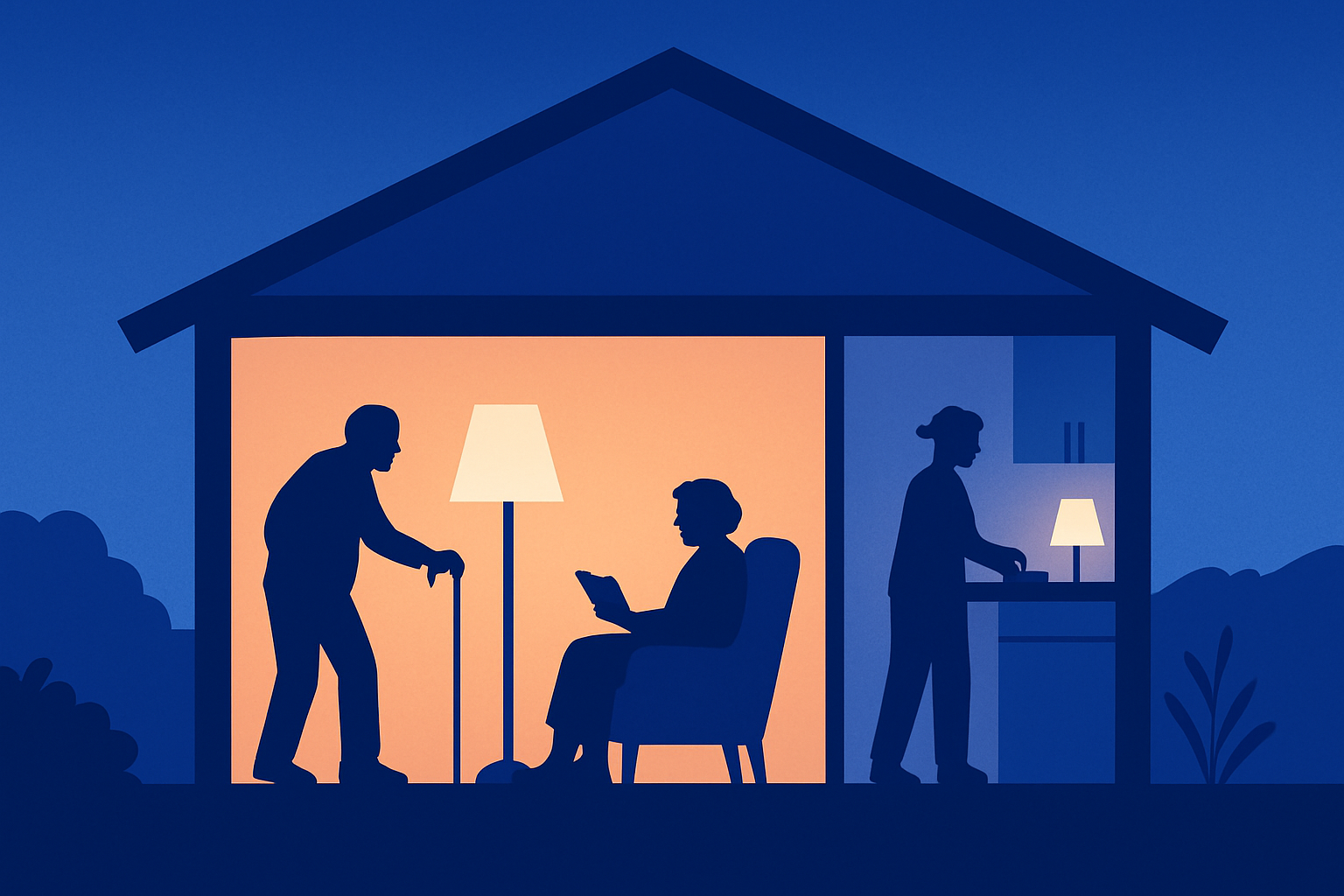
Most falls at home happen in places that look fine in daylight. The hallway between the bedroom and the bathroom. The first step of the stairs. The edge of the kitchen rug. The reason is not carelessness — it is often the lighting. Our vision dims as we age. The eye of a seventy-year-old needs roughly three times the lumens a twenty-year-old does to see the same scene, and the eye of an eighty-five-year-old needs more again. The home that worked for forty years does not stop working all at once. It dims quietly, and the family does not notice until something happens in the dark.
This is the practical lighting upgrade that moves the needle on fall prevention at home. It is not exotic, expensive, or technical. Most of it is solvable with bulbs, plug-in lamps, and a roll of high-contrast tape — in one afternoon, under two hundred dollars, before the next winter.
What older eyes actually need
Three things change in the aging eye that matter for home lighting.
- The pupil narrows, so less light reaches the retina at the same room brightness.
- The lens of the eye yellows, so colors compress and contrast flattens.
- The time it takes the eye to adjust between bright and dark increases — sometimes by a factor of three.
Together, those three changes turn a hallway from the bright bedroom into the dim bathroom into a passage the older adult cannot see clearly for several seconds after they enter it.
- Higher lumens, warmer colorRoughly 800–1,100 lumens per primary room fixture for general lighting, in a warm white (2,700–3,000 K). LEDs make this practical without driving the electricity bill.
- Layered light, not single overheadCeiling + table lamp + accent. A single overhead light casts shadows that hide steps and edges; a layered lighting pattern reveals them.
- Contrast at edgesA high-contrast strip on the first and last stair, a darker counter edge against a lighter floor, light switches in a color that contrasts with the wall behind them.
- No glareOlder eyes scatter glare more, not less. Frosted bulbs, lamp shades that diffuse, and matte (not glossy) floor finishes reduce the scatter.
The five places it matters most
Not every room needs the same upgrade. The biggest returns come from five locations, in this order:
- The path from bed to bathroomA motion-activated nightlight at the bedroom door, another along the baseboard of the hallway, and a low-level continuous nightlight in the bathroom itself. The 2 a.m. trip is the single most preventable fall in the home.
- The stairsLight at the top AND the bottom of every staircase, ideally on a switch reachable from both ends. High-contrast tape on the first and last riser. Many stair falls are not a stumble — they are a miscount when the eye cannot find the edge.
- The front entry, inside and outA dusk-to-dawn or motion-activated outdoor fixture so the arrival is lit, and a foyer lamp that the older adult can switch on without crossing a dark room.
- The kitchen countersUnder-cabinet LED strip lights so the working surface has direct light rather than the shadow of the cook. Many kitchen burns happen because the burner setting was not visible.
- The bathroom around the mirrorSide-mounted lights at the mirror, not just an overhead, so the face is lit from both sides. Medication labels, contact lenses, and shaving all happen better here than they do under the overhead alone.
The cheap, high-leverage list: Purchase three motion-activated nightlights, a sturdy plug-in lamp for any room that has only one light source, swap all the dim incandescent bulbs for warm-white LEDs at 800–1,100 lumens, and use a roll of high-contrast tape for the stairs and any thresholds. Total cost: well under two hundred dollars in 2026. It is the single most cost-effective home-safety upgrade most families ever make.
What about smart lighting?
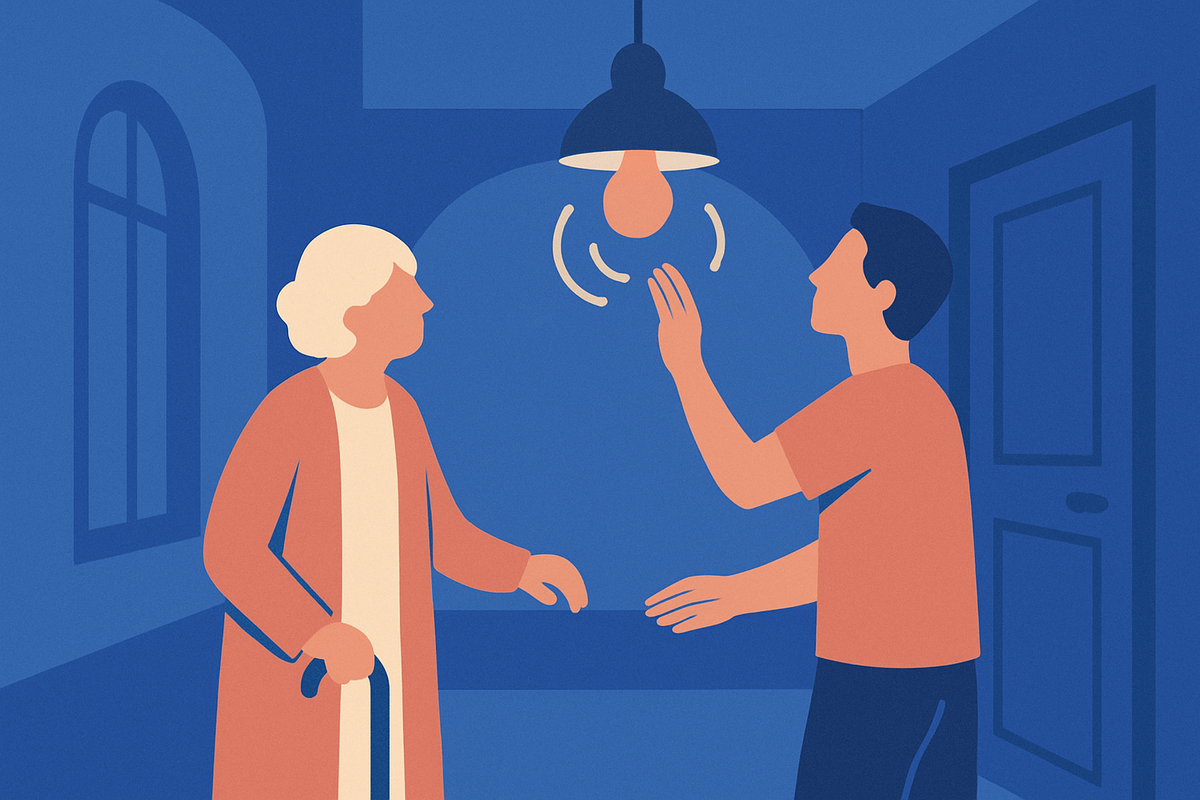
Smart bulbs and smart plugs are not necessary, but they can add value. Two use cases earn their keep with most older adults.
The first is a sunset-triggered schedule — lamps that come on automatically at dusk in the rooms the older adult uses in the evening, so they never enter a dark room and never have to remember to turn lights on.
The second is a phone-app control for a long-distance adult child who wants to confirm a parent has lights on in the evening without calling.
Both are quiet wins. Voice control is a third use case when it works with the person’s needs — but cognitive changes can make voice routines unreliable, and a physical switch on the wall is more durable.
What to skip: any smart system that requires the older adult to remember to charge a remote, swap a battery on a schedule, or update an app. The right test for any technology is whether it still works on the worst day, not the best one.
When to call an electrician
Most of the upgrade list is plug-and-replace. Three projects are worth a licensed electrician. Adding a switch at the top AND bottom of a staircase that currently has only one. Installing under-cabinet lighting that is hardwired rather than plugged into a counter outlet. And updating an old fixture in a bathroom or kitchen that does not provide enough light no matter what bulb is in it — the fixture itself is the limit, not the bulb.
Lighting is one piece of the broader home-safety walk; the room-by-room audit pairs with it directly. For the full checklist, see the home-modification checklist, and for the moment the audit produces a list longer than a renovation, the when aging in place stops working piece is the honest next read. The full housing-decision walkthrough sits at the stay-or-move decision guide, and the broader pillar — every guide as it ships — is at the Aging in Place & Moving hub.
Sources
About this post: Originally inspired by Cyndie Taylor's writing at taylormademoves.com — this is a fresh, expanded version written for the Aging Sidekick audience, not a republication.
Read Cyndie's original piece on taylormademoves.com — and find more of her writing on senior moves and aging in place at taylormademoves.com.
Run a 3-minute home safety audit
Walk through your parent's home one room at a time — kitchen, bathroom, bedroom, stairs — and Aging Sidekick flags the fall-prevention changes that matter most. Free, no signup needed for the audit itself.
Start the safety auditSee the full Aging Sidekick plan →