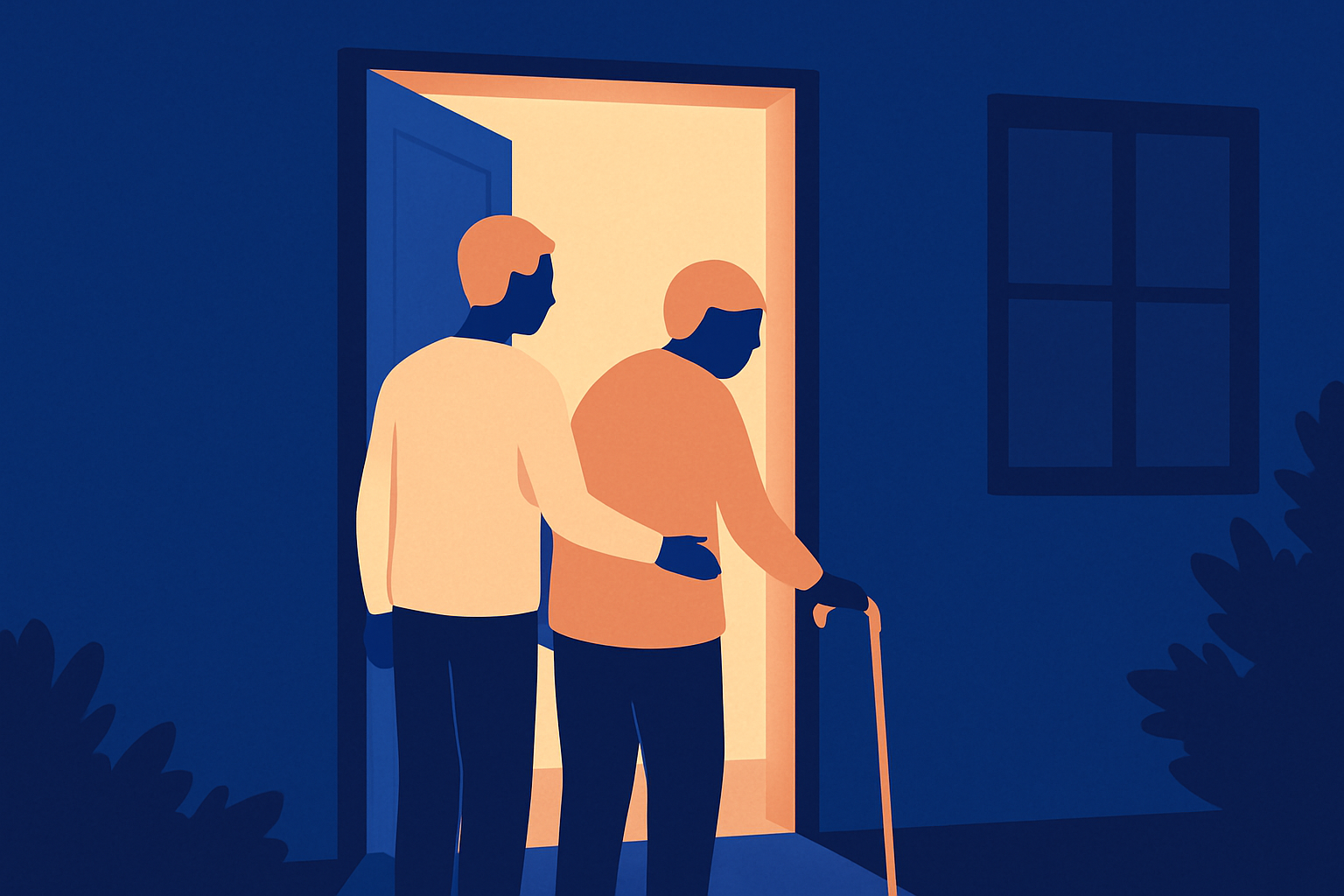
Anosognosia is a useful word to learn after a dementia diagnosis. It is the medical term for a particular kind of unawareness — a person whose brain literally cannot recognize the disease. It is not denial. It is not stubbornness. It is a feature of the disease itself, and once a family knows the word, a lot of frustrating moments start to make sense.
This guide walks through what anosognosia is, why it is different from denial, what to expect at home, the conversation moves that work better than logic, and how the family stays steady when the parent simply cannot see what the family can see.
TL;DR: Anosognosia is a brain-based unawareness, not an emotional defense. The parts of the brain that would normally recognize a deficit are themselves affected by the disease. Roughly 30 to 50 percent of people with mild-to-moderate Alzheimer's have some degree of anosognosia, and rates are even higher in frontotemporal dementia. Arguing logic does not help, because the brain mechanism that would integrate the logic is the part that is not working. The conversation moves that help are about safety, routine, and joining the parent where they are.
What anosognosia actually is
Anosognosia (an-oh-sog-NO-zee-uh) comes from Greek roots that translate roughly as 'lack of knowledge of disease.' It was first described in the late 1800s in stroke patients who could not recognize their own paralysis, and has since been documented in a range of brain conditions — strokes, traumatic brain injuries, schizophrenia, and most relevantly here, dementia. In dementia, anosognosia is most common in Alzheimer's, frontotemporal dementia, and some forms of vascular dementia.
The mechanism, in plain language, is this: recognizing that one's own brain is failing requires the brain to do a specific kind of self-monitoring work — comparing what one used to be able to do against what one is doing now, and noticing the gap. In several forms of dementia, the regions that perform that self-monitoring are themselves affected by the disease. The patient is not refusing to see the deficit. The patient literally cannot see it, because the seeing-it part is broken.
Why this is different from denial
Denial is an emotional defense. A patient in denial has the cognitive capacity to recognize the disease but cannot yet emotionally accept it. The defense usually softens over time, with support, with gentle re-exposure, with the help of a therapist or a trusted friend. Eventually most people in denial come to acknowledge what is happening.
Anosognosia does not soften, because there is no defense to soften. No amount of evidence, no amount of patience, no amount of love makes the unawareness lift. From the family's vantage point, denial and anosognosia can look identical — a parent who insists nothing is wrong while clearly struggling. The difference is what changes them. Denial responds to time and support. Anosognosia does not respond to anything, because the brain mechanism is not functioning.
For the related piece on the conversation moves that work when a parent will not engage with the diagnosis — whether the cause is denial or anosognosia or both — see How to talk to a parent in denial about their diagnosis. The framing is largely the same; the expectations are different.
What anosognosia looks like at home
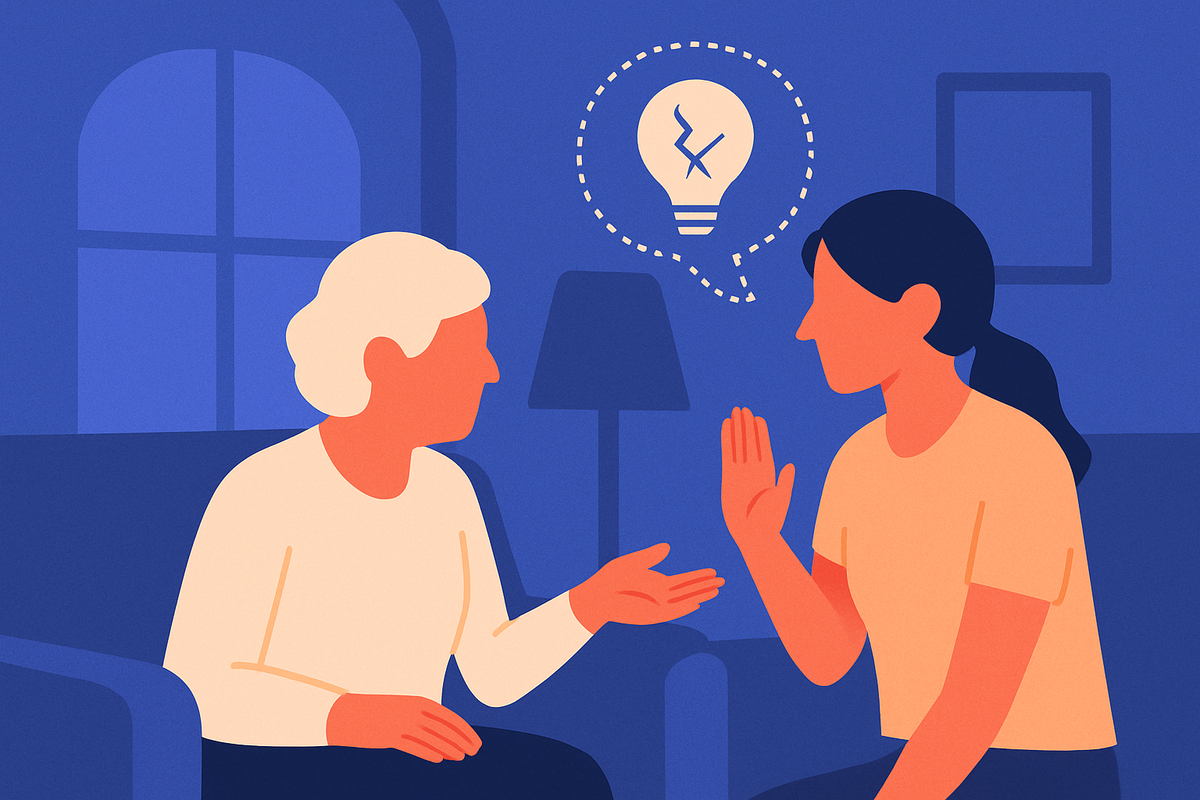
Anosognosia rarely looks like one big refusal. It usually looks like a thousand small moments. A parent who confidently describes herself as 'still driving great' the day after a fender-bender. A parent who insists he 'never had any trouble' with the medication, the day after missing the morning dose for the fourth time this week. A parent who is genuinely puzzled when family raises a concern, because from the parent's perspective there is nothing to be concerned about.
- Confidence about abilities that no longer match reality"I drive just fine." "I take my medications every day." "I cook every night." Sometimes none of these are true anymore — and the parent fully believes each one.
- Surprise or hurt when concerns are raisedThe parent is not performing surprise. The concern genuinely does not connect to anything they recognize about themselves. The hurt is real.
- Inability to acknowledge mistakes the family witnessedThe forgotten birthday, the lost keys, the missed appointment — the parent does not remember it happened, or remembers a version where it did not matter.
- Resistance to help that "is not needed""I do not need someone to come in. I am fine on my own." The resistance is not personality. It is the brain genuinely not registering the need.
- Sometimes moments of clarityMany families describe rare windows — a quiet afternoon, after a hospital stay, in a particular conversation — when the parent briefly acknowledges what is happening. The clarity may not last.
- Frustration when others "make it up"From the parent's view, the family is inventing a problem that does not exist. The frustration is real, and the family loving them is not the version they are seeing.
What works (and what does not)
Three things tend not to work, and two things often do. The list below is widely shared in family-support communities and routinely echoed by clinicians familiar with anosognosia.
What does not work: showing the parent the evidence (the lost-keys log, the dented bumper, the unopened medication), arguing the diagnosis ("the neurologist said"), and asking the parent to agree they need help. None of these reach the unawareness, because the mechanism that would integrate them is the part that is not working. Each one tends to add frustration without changing anything.
What often works: joining the parent where they are, and working the consequences quietly. Joining means meeting the parent's stated reality with kindness — "OK, you are doing great. Help me set up the paperwork so I can spend more time with you instead of worrying." Working the consequences means making the home safer, the bills paid, the medications managed, the rides arranged — without requiring the parent to acknowledge that any of it is for the parent's benefit.
What this means for the family's job
Once a family understands anosognosia, the family's job often gets smaller and clearer. Convincing the parent the diagnosis is real is not the job — because the job cannot be done. Loving the parent and keeping them safe is the job, and the work is more about adjusting the environment than adjusting the parent's mind.
That clarity sounds simple, but it is hard-won. Most families need months — sometimes years — to give up on the version of the conversation where the parent finally agrees. Letting go of that version is its own grief, and it overlaps with the bigger grief that often surfaces in this stage of the disease.
For the longer piece on that quiet, anticipatory grief — the grieving that often begins before any loss — see Anticipatory grief: mourning who your parent used to be. For the broader first-month playbook this conversation feeds into, see The First 30 Days After a Dementia Diagnosis. For the longer pillar of related guides, the Dementia & Alzheimer's hub has the full set.
Three practical moves
Three small habits make living with anosognosia steadier. Each one is widely shared in family-support communities.
First, name it. Tell the siblings, the in-laws, the close friends. The word turns a confusing pattern into a known condition. Second, keep a quiet log. Date, what happened, how it was handled. The log is for you and the doctor, not the parent. Third, take the win when the parent is briefly cooperative — sign the document in the lucid window, do the tour on the calm afternoon. Anosognosia is not perfectly steady; the windows are real, and they close.
A note on what helps: Aging Sidekick can help you turn months of small observations into a one-page summary you can hand to a sibling, the primary-care provider, or the neurologist — built from a fifteen-minute voice intake. Free to start. We complement, not replace, your healthcare team.
Get a dementia care roadmap
Aging Sidekick assesses your parent's specific situation across 18 dimensions and outputs a Life Plan you can act on — for the first 30 days and beyond.
Start your care roadmapSee how it works for dementia families →