
ER discharges happen fast, and the instructions can feel confusing or overwhelming. There may be a lot of new information to understand, new terminology, and new medications or care needs. The nurse hands you a printout of the discharge papers, the door slides open, and you are walking your elderly loved one to the car. The next twenty-four hours are when the small things become big — a missed dose, instructions that are difficult to follow, pain that was managed in the ER but is not now.
This guide is the first-twenty-four-hours plan for the family bringing an elderly loved one home from the emergency department: what to ask before you leave, what to set up tonight, who to call, and how to write down what you saw so the next provider can use it. Plain language. Built from the questions families ask after the discharge papers stop making sense.
TL;DR: Before you leave the ER, ask three things: what is the working diagnosis for what caused this trip to the ER, what changed about the medication list, and what warning signs should you watch for, to know when to call back. At home, set up a 'command station' with the printout, the medication list, a glass of water, and a phone within reach. Do three check-ins in the first 24 hours: at four hours, at eight hours, and at twenty-four hours. Write down anything that feels off — even if it does not feel urgent.
Before you leave the ER: key questions to ask
ER discharge papers contain a wealth of information, with medical terminology that can make the instructions difficult to understand. It might feel like there is no time to ask questions, as the staff is moving quickly to care for multiple patients. After the discharge paperwork is printed, and before you head to the parking lot, take a moment to ask the questions around what you’re unclear on or terminology that is new to you. Following are three key questions to ask.
First: what is the working diagnosis? ER diagnoses may be described as 'most likely' rather than confirmed — the imaging or the labs may still be pending. Ask whether anything is still being followed up on.
Second: what changed about the medication list? Did the ER start anything new, stop something, or change a dose? That medication change is typically included in the discharge summary. Circle it, make notes on the summary so you’re clear on what needs to change after you go home.
Third: what warning signs mean call back, and what means come back? The goal of the ER is to stabilize the patient and move them to the correct setting for their immediate care needs. They don’t want to see you back in the ER. So take a moment to learn: who should we call with concerns? Primary care provider, a specialist? What should we report to the doctor’s office, vs what might be an emergency? Get both lists, specific to the working diagnosis, before the you leave.
For the longer printable version of the questions to ask before any hospital discharge, see What to ask the hospital case manager. ER discharges are shorter conversations but follow the same pattern.
The 'command station' on the main floor
Inside the first hour at home, set up a single spot on the main floor where everything for the next twenty-four hours lives: the ER printout, the printed medication list, a glass of water, the number to call with questions, a phone within reach, and a small notebook or notes app to write down anything you notice. One spot for everything.
If your family member will be sleeping on a different floor than usual, the command station goes wherever they will actually be — the couch, a daybed in the living room, a guest bedroom. The point is that everything anyone might need at 3 a.m. is within one arm's reach of where they are. The middle of the night is not when you want to be hunting for a sticky note.
Three check-ins, on a clock
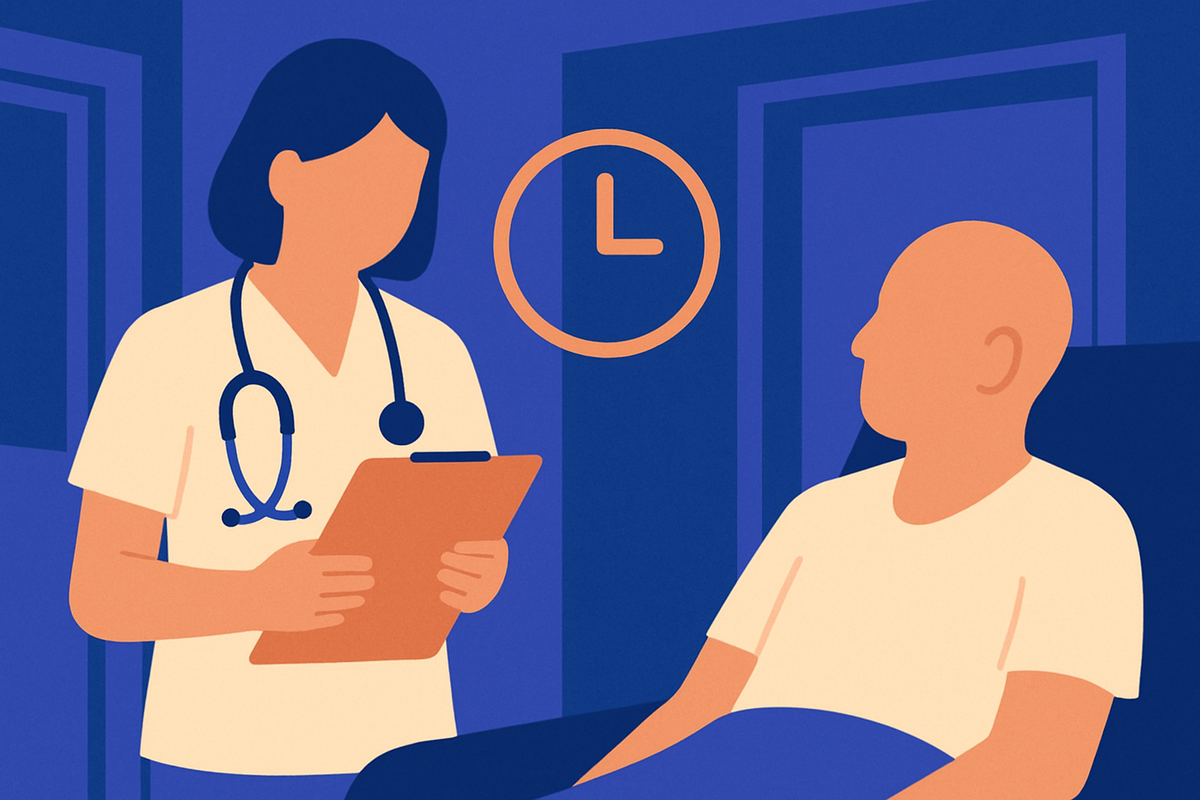
Pick one person to be the discharge-day point of contact for the first twenty-four hours. Not the whole family — one person. That person does three check-ins, on a clock.
- Four hours: are we home and settled?A call or text to the family at four hours after discharge: home, eating something light (if that fits the discharge instructions), water beside the chair, first dose if appropriate.
- Eight hours: how is the first night going?Pain level, mobility to the bathroom, any new symptom, any confusion. Write the answers in the notebook so the trend is visible the next morning.
- Twenty-four hours: how was the night?Sleep quality, pain on waking, appetite at breakfast, any swelling, any change in alertness. Compare against the warning-signs page.
- Save two numbers in the phoneThe after-hours nurse line and the follow-up provider. Both saved before the first night, not during it.
- Print the medication list (or photograph it)One copy taped inside the kitchen cabinet, one photo in the phone of every adult in the home. Two backups beat one.
- Tape the warning-signs page to the fridgeThe page from the ER printout that names red flags — this might include confusion, fever, swelling, sudden pain, trouble breathing — taped where every adult and any visiting helper will see it.
Medications: what the ER probably did not reconcile
Medications may change after an ER visit; it’s important to complete a medication reconciliation after returning home to ensure medications are taken correctly. The ER team may have added one new medication (for pain, for an infection, for a specific symptom). At home, gather every bottle on the kitchen counter and lay the ER printout next to them.
Three things to look for: a duplicate (the ER started a new blood-pressure medication but the home version is still in the pill organizer), an interaction (the ER started a new antibiotic that does not play well with a chronic medication), and a gap (a familiar pill that was skipped during the ER stay and has not been restarted). When in doubt, call the after-hours nurse line or the pharmacist.
The companion post What is medication reconciliation — and why your parent’s list is wrong walks through this exercise in more detail.
What to write down (even when it does not feel urgent)
Write down anything that feels off in the first twenty-four hours, even if it does not feel urgent. Vague observations turn into useful sentences when you write them as you notice them. 'A little more confused than usual after dinner' is far more useful, three days later, than 'she has not seemed quite right.'
Date the entries. Time them. Note what your parent was doing when the change happened (waking up, after a dose, after walking to the bathroom). The notebook will give the primary-care provider good insight into your family member’s day-to-day condition.
When to call the nurse line (and when 911)
The triage tree is a key caregiving skill to learn. Call 911 for chest pain or pressure, sudden one-sided weakness or slurred speech, severe shortness of breath, a fall with a head strike or possible broken bone, severe bleeding, a sudden change in consciousness, or any warning sign the ER printout specifically names as 'call 911.'
Call the after-hours nurse line for changes or symptoms that feel abnormal but are not in the 911 list. A new pain, a low-grade fever, mild confusion, a missed dose, a question about whether to take or hold a medication, a wound that looks different. Nurse lines exist for exactly this conversation, and they can triage to ensure it’s not an emergency, provide guidance, and generally reassure the caregiver so you’re confident in the care you’re providing.
For the longer two-week window this first night fits inside, see Why hospital readmissions happen — and how to prevent the next one. For the broader 48-hour playbook the ER discharge is a faster version of, see The 48-Hour Hospital Discharge Plan. For the longer pillar of related guides, the Hospital Discharge hub has the full set.
A note on what helps: Aging Sidekick can help you turn the first 24 hours into a one-page plan — the command station, the check-in clock, the medication list, the warning signs — built from a fifteen-minute voice intake. Free to start. For chest pain, stroke symptoms, severe bleeding, sudden weakness, or trouble breathing, call your local emergency number.
Plan a safe discharge with Aging Sidekick
Aging Sidekick walks you through every question, document, and decision before your parent leaves the hospital — built around the specific care situation in front of you.
Start your discharge planSee how Aging Sidekick helps →