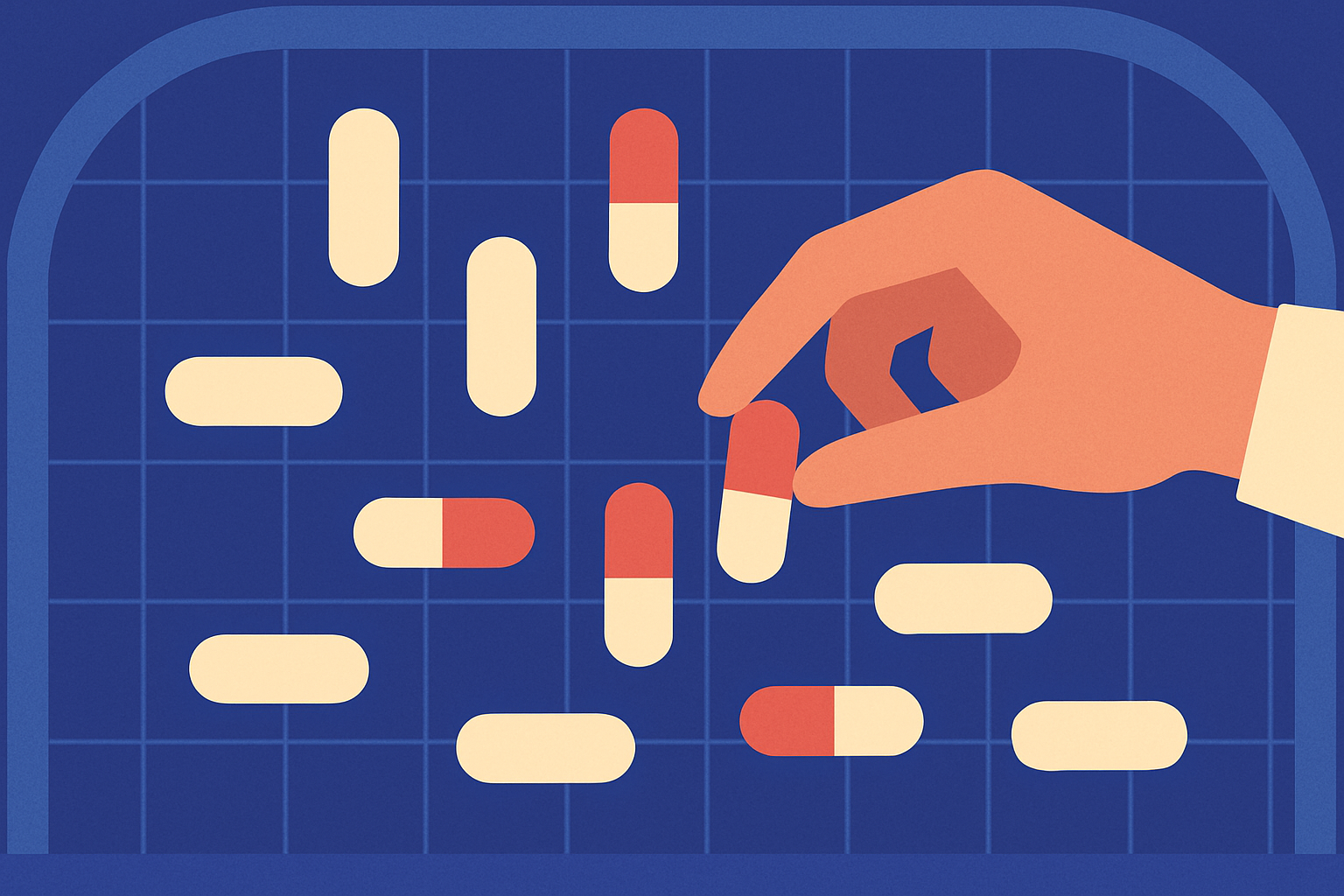
Polypharmacy is the medical term for taking many medications at once. The threshold most clinicians use is five or more daily prescriptions — and by that count, roughly two in five adults over sixty-five in the United States meet it. After seventy-five, the share of older adults taking five-plus prescriptions daily climbs again, and the medication list becomes one of the most important parts of the care plan.
This post is a plain-language overview of polypharmacy: what the word means, why the risk climbs with age, what families and pharmacists watch for, and the questions to bring to the next doctor visit. We do not make recommendations on changes to your parent's medication regimen — that is the doctor's call. We do recommend that the medication list is actively managed and discussed with the PCP.
TL;DR: Polypharmacy is generally defined as five or more daily prescription medications. The reason it matters more after seventy-five is biological — older bodies clear drugs more slowly, organ function shifts, and the chance that two medications interact climbs with every new bottle. The annual medication review is incredibly valuable. A useful question at any visit is: 'is there anything on this list we could safely stop?'
Defining polypharmacy
Polypharmacy is when someone is taking five or more medications daily. Many older adults need five, eight, or twelve daily medications because they live with several chronic conditions at once — high blood pressure, diabetes, atrial fibrillation, osteoporosis, depression, pain. Each prescription was given with the intention to resolve a medical concern. There can be risks from taking multiple medications - not from any single bottle, but from the way the list increases. It’s important to take a moment each year to step back to look at the whole picture.
The American Geriatrics Society and the National Institute on Aging both use polypharmacy as a flag — a sign the medication list deserves a second look. The medical literature distinguishes 'appropriate polypharmacy' (every drug serving a clear purpose, balanced against side effects) from 'inappropriate polypharmacy' (medications that are duplicative, no longer needed, or causing more harm than benefit). A structured medication review can differentiate the two.
Why the risk climbs after seventy-five
Three biological changes drive the risk as we age. First, the kidneys and the liver — the two organs that clear most medications from the body — slow down with age. A dose that was right at sixty can become too high at eighty without the prescription changing. Second, body composition shifts: less muscle, more fat, less water. Drugs that distribute through water (many blood-pressure medications, lithium, digoxin) reach higher concentrations than the dose would suggest. Third, the brain becomes more sensitive to sedating medications, anticholinergics, and certain pain medications.
On top of the biology, the math of interactions changes. A parent on two medications has one possible interaction to track; a parent on ten has forty-five. The pharmacist's job at every refill is to catch those interactions, and pharmacists do good work — but the family is the only person looking at the whole list across pharmacies, hospitals, and specialists. That is part of what makes the family's role on medication so important after seventy-five.
What families and pharmacists watch for

A few patterns show up over and over in the medication-safety literature and in family-support communities. None of these on its own means a change is needed — but each one is a reason to mention the list at the next doctor visit and to ask whether anything could safely come off.
- New confusion, drowsiness, or falls after a prescription changeNew or worsening confusion, sedation, balance problems, or falls within a few weeks of a medication change. The timing is what matters — write down when the new medication started.
- Two medications doing the same jobTwo blood-pressure medications in the same class, two pain medications, two sleep medications. Sometimes intentional. Sometimes accumulated by mistake when prescribers changed.
- A "prescribing cascade"A side effect of one medication treated with a second medication, whose side effect is treated with a third. The geriatrics literature calls this a cascade; the family can sometimes spot it backward in time.
- Anticholinergic burdenA collection of common medications — some allergy pills, some bladder medications, some older antidepressants — that share a side-effect profile (confusion, dry mouth, constipation, urinary retention). The cumulative load can outweigh the benefit.
- Medications that may have outlived their purposeA bone-density medication started ten years ago. A statin started before a major life change. A daily proton-pump inhibitor started "for a few weeks" in 2014. Worth asking: is this still needed?
- New supplements added without telling the doctorMany over-the-counter supplements and herbal products interact with prescription medications. The pharmacist needs to know about everything on the kitchen counter, not just the prescriptions.
What the family can do
As a family member, you can drive effective conversations by keeping a master list that is current across pharmacies, asking whether the prescription list can be shortened, and bringing observations from home.
The master list should be recorded one printed page: drug name, strength, schedule, prescriber, reason. Update it every time a bottle changes. Bring a printed copy to every appointment and to every ER visit. For the practical step-by-step of building it, the cornerstone guide walks through the kitchen-counter method.
For the full step-by-step on building and maintaining the master list, plus how to run an annual review with the doctor or pharmacist, see The Caregiver's Guide to Managing Your Parent's Medications. The annual review itself is a useful tool — for the deeper piece on what to ask and who can run it, see The medication review every senior should get every year. For the related conversation about whether the latest prescription belongs on the list at all, see When to push back on a new prescription.
The questions for the next visit
Most medication safety in the home is downstream of a calm, recurring conversation with the prescriber. Three short questions, asked at every visit, are usually enough.
- "Can we go through the whole list?"Bring the printed master list. Ask the doctor or pharmacist to walk through it, one bottle at a time.
- "Is anything on this list we could safely stop?"The medical word is "deprescribing." Especially worth asking after eighty.
- "What new symptoms should we report?"For every new prescription, ask what to watch for in the first two weeks. Write the answer in the medication list.
The Beers Criteria — the geriatrics field's consensus list of medications carrying extra risk in adults over sixty-five — is one of the standard references behind the deprescribing conversation. For the plain-language tour, see The Beers List: medications older adults shouldn't take. For the longer pillar of related guides, the Medications hub has the full set.
A note on what helps: Aging Sidekick can help you turn the pill bottles on your parent's counter into one clean medication list — built from a fifteen-minute voice intake or a few photos. We organize the list. The pharmacist reviews it. The doctor prescribes. We complement, not replace, your healthcare team. Never change a medication regimen on your own — that is a conversation for your parent's doctor or pharmacist.
Build your parent's medication plan
Aging Sidekick captures every prescription, OTC, and supplement your parent takes — voice intake or document upload — and gives you back a clean, shareable medication list with side-effect flags.
Start a medication planSee the medication-management walkthrough →